Monarch Money vs. Quicken Simplifi
Two excellent financial dashboards, separated by household design, planning depth, and sixteen dollars a year.
Bottom line: Monarch Money beats Quicken Simplifi by four categories to three in 2026. Monarch is the better complete household system, with stronger collaboration, planning, and goals. Simplifi is faster and cheaper, making it the better choice for solo users who mainly want a clear monthly Spending Plan.
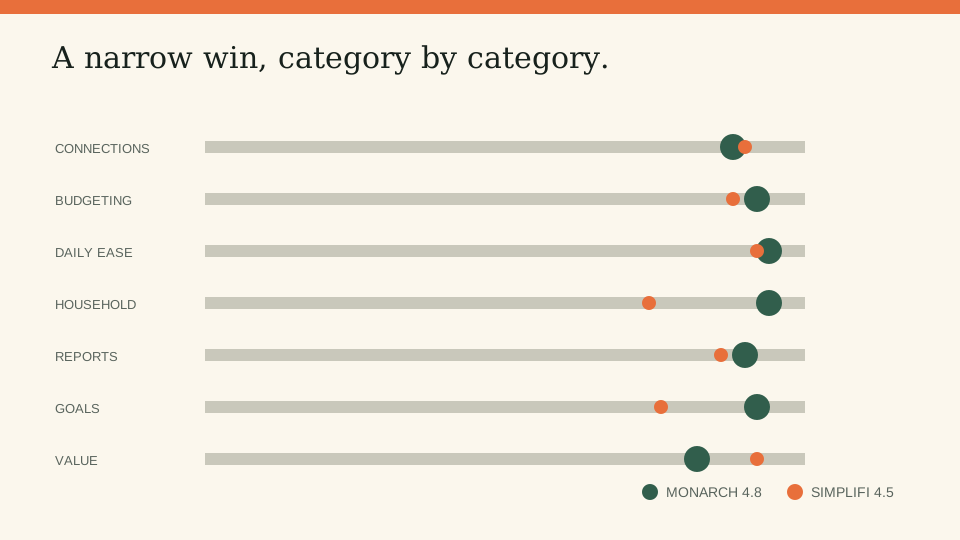
This is a close comparison because both apps solve the same core problem competently: they connect financial accounts, organize transactions, anticipate bills, and show whether current spending fits the month. We tested each daily with the same account mix and weighted the categories according to our published methodology. The winner changes when a buyer’s priorities change.
The comparison at a glance
| Category | Monarch Money | Quicken Simplifi | Winner |
|---|---|---|---|
| Standard price | $99.99/year or $14.99/month | $83.88/year equivalent; annual billing | Simplifi |
| Budget method | Category or flexible planning | Income-minus-obligations Spending Plan | Monarch |
| Daily workflow | Detailed transaction review | Fast available-to-spend check | Simplifi |
| Couples & households | Separate logins in one household | Sharing is less developed | Monarch |
| Goals | Flexible account allocations | Savings goals within plan | Monarch |
| Reports | Strong cash flow and net worth | Excellent filters and watchlists | Simplifi |
| Complete financial view | More coherent planning workspace | Good overview, lighter planning | Monarch |
| Final | 4 wins · 4.8/5 | 3 wins · 4.5/5 | Monarch |
Budgeting: Monarch offers more choice
Monarch lets a user plan every category or group most variable spending into one flexible number. Non-monthly expenses can be funded separately, and rollovers work at a granular level. The system accommodates careful planners without forcing that level of attention on everyone else.
Simplifi’s Spending Plan is more opinionated. Expected income arrives first; bills, subscriptions, savings, and planned categories come out; available spending remains. We could understand it faster, and it handled an ordinary month beautifully. Monarch wins because its two modes fit more budgeting temperaments, but Simplifi’s narrower answer may be better for someone exhausted by envelopes.
Daily use: Simplifi gets to the number faster
Both apps import and categorize transactions well. Monarch’s review screen has richer rules and clearer household context. Simplifi counters with a cleaner route from opening the app to answering “what can I spend?” Its watchlists also isolate one habit—restaurants, online shopping, a particular merchant—without turning that curiosity into a formal budget.
Our connection results were close enough that no universal winner is responsible. Financial institution support can differ from one user to another. Test every must-have bank and card before paying, and review imported balances rather than assuming a successful login means accurate data.
Households and goals: Monarch pulls ahead
Monarch treats a household as a first-class unit. Members receive separate logins while contributing to the same transaction list, budget, and goals. Partners do not have to share an app password or banking credentials. This design alone can be worth the $16.11 difference between the standard annual prices.
Its goals also connect naturally with account balances. Simplifi’s savings goals work and reduce available spending appropriately, but they feel like components inside the month rather than a long-range planning layer. Neither product moves money; both are organizing and forecasting tools. Monarch simply explains the relationship among present accounts, future goals, and household decisions better.
Reports and price: Simplifi answers back
Simplifi has excellent report filtering and focused watchlists. Its projected cash flow is useful when timing matters: an affordable month can still contain a low-balance Tuesday. Monarch offers good cash-flow, spending, income, and net-worth reports, but Simplifi’s views often require fewer clicks for a specific question.
Monarch Core lists at $99.99 annually or $14.99 month-to-month after a seven-day trial. Simplifi displayed a standard $6.99 monthly equivalent billed annually—$83.88 total—alongside a $3.99 promotion on August 5, 2026. Because promotions and renewals vary, our comparison uses the standard price. Simplifi wins value even before a temporary discount.
Our recommendation
Pay for Monarch if two people will participate, if goals are central, or if you want the budget to adapt as your planning style evolves. It is our number-one budgeting app of 2026 because it avoids a major weak area, not because it wins every category. Read the full Monarch Money review for the 95.4-point score breakdown.
Choose Simplifi if you are one primary user, want quick monthly clarity, and prefer spending less. The Simplifi review explains its 90.2-point result and the pricing language to inspect at checkout. If neither description sounds right, our selection guide starts with budgeting behavior rather than brand.
Reports are one of the closest categories on paper. Our case study of five Monarch charts that changed decisions shows where flexibility becomes practical.
Monarch vs. Simplifi FAQ
Which is better overall, Monarch Money or Simplifi?
Monarch Money is better overall by a narrow margin. It wins our comparison 4–3 and scores 4.8/5 against Simplifi’s 4.5/5. Monarch’s flexible budgets, separate household logins, and better goals justify the lead. Simplifi remains the smarter buy for a solo user focused on monthly cash flow.
Which app is cheaper?
Simplifi is cheaper at its $6.99 monthly equivalent billed annually, or $83.88 per year, and its displayed introductory offers may cost less. Monarch Core costs $14.99 monthly or $99.99 annually. Compare renewal prices rather than temporary discounts; both services require payment after their trial or introductory period.
Which app is better for couples?
Monarch is clearly better for couples. One household subscription supports separate member logins, so partners can share the same plan without sharing app or bank credentials. Simplifi can work for a couple who manages money together, but its sharing and permissions feel less deliberately designed around two equal participants.