The 7 best budgeting apps, tested and ranked
One overall winner, six excellent alternatives, and no imaginary perfection.
Monarch Money is the best budgeting app of 2026, scoring 4.8/5 for flexible planning, shared household access, and a complete financial view. Quicken Simplifi ranks second at 4.5/5 and offers better value. YNAB places third for people who want an intentional, hands-on budgeting method.
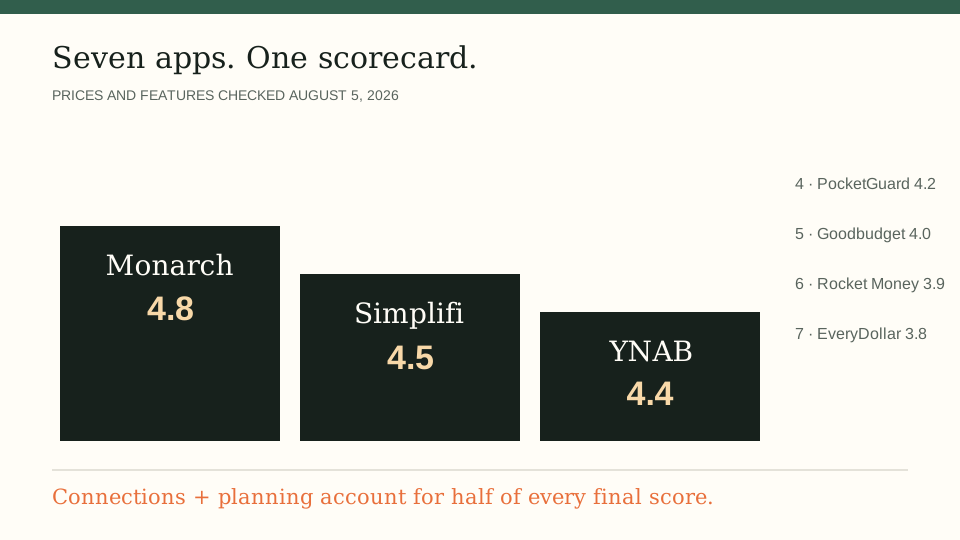
We tested every finalist for at least four weeks, using real transactions across checking, savings, credit cards, loans, and investments where supported. Scores weight connection accuracy and budgeting at 25% each, daily ease and household features at 15% each, then insights and value at 10% each. No company paid, sponsored, or approved its position.
Results at a glance
| Rank | App | Score | Best for | Price checked | Main drawback |
|---|---|---|---|---|---|
| 1 | Monarch Money | 4.8/5 | Best overall | $99.99/year | Premium price |
| 2 | Quicken Simplifi | 4.5/5 | Value and cash flow | $6.99/month equivalent, annual | Limited household design |
| 3 | YNAB | 4.4/5 | Method-driven budgeting | $109/year or $14.99/month | Learning curve |
| 4 | PocketGuard | 4.2/5 | Overspending guardrails | $74.99/year or $12.99/month | Less planning depth |
| 5 | Goodbudget | 4.0/5 | Manual envelopes | Free; Plus $80/year | Manual entry on free tier |
| 6 | Rocket Money | 3.9/5 | Subscription cleanup | Free; Premium typically $7–$14/month | Key tools behind Premium |
| 7 | EveryDollar | 3.8/5 | Simple zero-based plans | Free; Premium $79.99/year | Rigid approach |
Monarch Money
Best overall. Monarch combines category and flexible budgeting with transaction rules, goals, investments, net worth, and excellent household collaboration. The web app feels as considered as mobile, and separate member logins make it our clear pick for couples.
Honest con: Core costs $99.99 annually or $14.99 monthly, too much for basic tracking. Some institutions still need a refresh. Our full Monarch review explains its 95.4/100 weighted result.
Quicken Simplifi
Best value paid app. Simplifi subtracts bills, subscriptions, goals, and planned categories from income to show what remains. Watchlists make it easy to monitor one behavior without constructing another budget. Reports are flexible, and projected cash flow helps with timing.
Honest con: Couple and household workflows are less polished than Monarch’s, and displayed introductory pricing can obscure the renewal cost. Read our Simplifi review or the direct comparison.
YNAB
Best for learning a method. YNAB asks users to assign the money they already have, embrace true expenses, and adjust as life changes. That active process can transform spending decisions rather than merely report them. Its education and community are unusually strong.
Honest con: The method takes time, and $109 annually or $14.99 monthly is expensive for software that expects substantial user participation. It is brilliant for willing students and frustrating for anyone seeking autopilot. See the official YNAB site.
PocketGuard
Best guardrail against overspending. PocketGuard’s central “Leftover” figure turns income, recurring obligations, goals, and spending into a practical limit. It is easier to absorb than a dense category sheet, and debt-payoff tools broaden its usefulness.
Honest con: Detailed long-range planning and reporting trail the top three. Premium listed at $74.99 annually or $12.99 monthly, so the monthly plan is hard to justify. Test institution support during the seven-day trial.
Goodbudget
Best manual envelope system. Goodbudget divides planned income among familiar digital envelopes and makes a household plan easy to discuss. The free level is useful without connecting a bank, appealing to people who prefer deliberate entry or do not want to share account data.
Honest con: Manual transaction upkeep becomes a chore at high volume. Plus adds automatic bank sync in the US for $10 monthly or $80 annually, but its interface and reporting feel plainer than similarly priced competitors.
Rocket Money
Best for finding subscriptions. The free app identifies recurring charges and gives a quick spending overview; Premium adds cancellation assistance, more budgets, rules, net worth, and other tools. It is an effective first audit for someone unsure where money leaks.
Honest con: Budgeting is not as deep as Monarch, YNAB, or Simplifi, and many useful controls require Premium. Rocket Money said Premium typically ranged from $7 to $14 monthly when checked; bill-negotiation services can involve separate success-based fees.
EveryDollar
Best simple zero-based template. EveryDollar offers a clean plan built around assigning every dollar of expected income. The free version supports manual budgeting, while Premium adds bank transaction streaming, paycheck planning, goals, and insights.
Honest con: The opinionated method leaves less room for households that prefer flexible spending pools. Premium is $79.99 annually after a 14-day trial, or $17.99 monthly, making month-to-month use particularly expensive.
How to use this ranking
A score measures broad performance, not personal fit. Write down whether you will enter transactions, whether another person needs a separate login, which institutions must connect, and what the service costs after promotions. Then use our seven-question choosing guide to narrow the list to two trials.
Run each finalist through one payday, one recurring bill, a refund, and a category correction. The app that makes those ordinary events clearest is more likely to survive past January than the one with the longest feature page. If a term such as rollover or zero-based budget is unfamiliar, our plain-English glossary is the quick morning read.