Quicken Simplifi review: the smart value pick
A fast, friendly Spending Plan that tells you what remains after bills, goals, and planned expenses.
Verdict: Quicken Simplifi earns 4.5/5 after 35 days of testing and is our best-value paid budgeting app for 2026. Its Spending Plan makes monthly cash flow unusually easy to read, while strong reports reward deeper use. Monarch Money remains our overall winner for households and long-range planning.
Simplifi is Quicken’s web-and-mobile personal finance app, separate from the older Quicken Classic desktop software. That distinction matters: Simplifi feels modern, updates automatically, and asks no one to manage a local data file. We connected six accounts and used the app through a month-end, one pay cycle, and several irregular expenses.
What worked
- Clear, adaptive Spending Plan
- Excellent value at standard pricing
- Watchlists focus on chosen spending
- Useful reports and projected cash flow
- Fast web and mobile workflows
What did not
- No permanent free tier
- Annual billing only on displayed plans
- Household tools trail Monarch
- Goals feel less connected to the plan
- Promotional pricing can confuse
How Simplifi scored
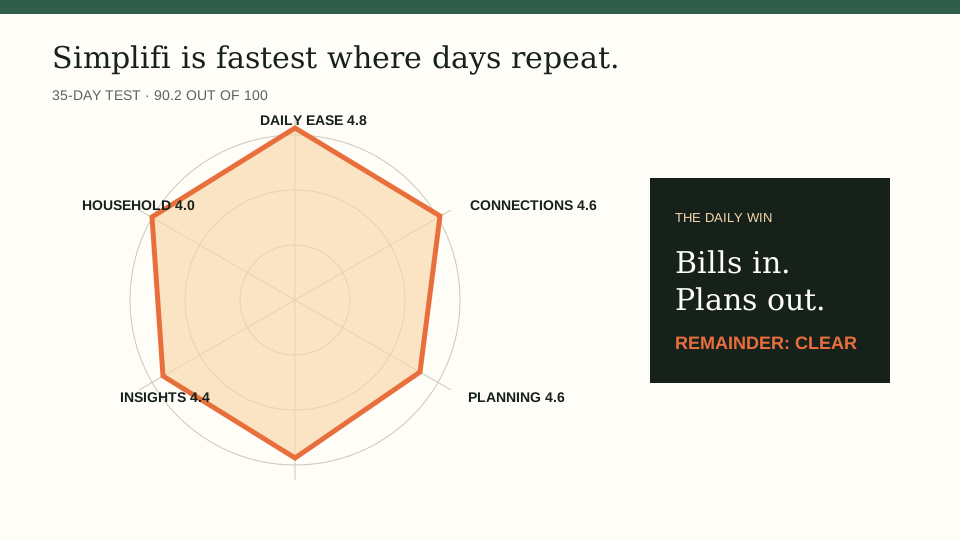
| Category | Weight | Score | Weighted points | Desk note |
|---|---|---|---|---|
| Connections & accuracy | 25% | 4.6/5 | 23.0/25 | Dependable imports in our set |
| Budgeting & planning | 25% | 4.6/5 | 23.0/25 | Excellent monthly cash flow |
| Daily ease | 15% | 4.8/5 | 14.4/15 | Short, focused check-ins |
| Household tools | 15% | 4.0/5 | 12.0/15 | Sharing is less elegant |
| Insights & goals | 10% | 4.4/5 | 8.8/10 | Strong reports, basic goals |
| Value | 10% | 4.5/5 | 9.0/10 | Good standard annual rate |
| Total | 100% | 4.5/5 | 90.2/100 | Best-value paid pick |
The Spending Plan is the reason to subscribe
Simplifi does not lead with a grid of categories. It begins with expected monthly income, removes recurring bills and subscriptions, subtracts savings goals and planned spending, and labels the balance “available.” That number changes as transactions arrive. It answered our most common weekday question—how much room is left?—without demanding that every purchase receive a preassigned envelope.
Planned spending can still set limits for groceries, restaurants, or any other category. Unused amounts can be released back to the plan. The result is flexible, but not shapeless. It worked especially well during a month with a car insurance bill and a birthday: both were visible before they made an ordinary week look unexpectedly expensive.
Watchlists and reports add focus
Watchlists track a category, payee, or tag against an optional target. We created one for coffee shops and another for ride-share purchases. Each showed an average, current total, and projected monthly total. A watchlist is not a hard budget; it is a small spotlight. That makes it useful for behavior someone wants to observe without rebuilding the whole plan.
Reports cover spending, income, net income, savings, and net worth. Filters are unusually practical. The projected cash-flow view adds upcoming bills and income to an account balance, helping prevent a checking-account squeeze even when the month looks affordable overall. Investment tracking is adequate for balances and holdings, not a substitute for portfolio-analysis software.
Connections were quiet, which is praise
Five of six institutions connected on the first attempt. The sixth needed a fresh authentication code, then remained stable. Automatic categories were correct on 88 of the first 100 transactions; merchant-specific rules improved later imports. Pending and posted duplicates resolved without intervention in our test.
No aggregator connects every institution perfectly, so prospective buyers should use the initial period to test their own bank, credit union, and loan servicer. Our budgeting app selection guide explains how to run that trial before committing to a year.
Pricing is good, though displayed awkwardly
On August 5, 2026, the official Quicken Simplifi page displayed $3.99 per month beside a $6.99 regular price, billed annually. The standard rate therefore works out to $83.88 per year; the displayed promotion may apply only to an introductory term. Check the checkout total and renewal language rather than multiplying the largest number on the page.
Simplifi costs less than Monarch’s $99.99 standard annual plan and often discounts more aggressively. Even so, Monarch Money earns our 4.8/5 top score because it handles household collaboration, custom planning, and goals better. Our side-by-side comparison shows exactly where the extra cost produces extra utility.
Who should choose Simplifi?
Choose Simplifi if you want a low-maintenance view of bills, goals, discretionary spending, and account balances. It suits solo users and couples who coordinate informally, especially people who have abandoned category-heavy budgets. Skip it if you need a permanent free plan, separate household logins with carefully shared visibility, or a strict give-every-dollar-a-job method.
It is a strong second place, not a consolation prize. In our full 2026 ranking, Simplifi finishes ahead of YNAB for general use because it asks less of the user while still encouraging attention. YNAB remains stronger for people who explicitly want its method.
A good Spending Plan still needs a repeatable review. Our 20-minute Sunday money reset shows the weekly checklist we kept for eight weeks.
Quicken Simplifi FAQ
How much does Quicken Simplifi cost in 2026?
On August 5, 2026, Simplifi displayed a $3.99-per-month promotional price beside its $6.99 standard monthly equivalent, both billed annually. That makes the regular annual cost $83.88. Promotions and renewal terms change, so confirm the full checkout total and renewal price before subscribing.
Is Simplifi better than Monarch Money?
Simplifi is better for value, quick setup, and people who think in monthly cash flow. Monarch Money is better for couples, flexible budget structures, goals, and a more complete net-worth workspace. We rate Simplifi 4.5/5 and Monarch 4.8/5, so the choice depends more on scope than quality.
Does Simplifi use zero-based budgeting?
Not in the strict YNAB sense. Simplifi’s Spending Plan starts with expected income, subtracts bills, subscriptions, savings goals, and planned spending, then shows what remains available. It is easier to maintain than assigning every dollar, but people who want firm envelope constraints may find it too permissive.
Testing note: Theo paid for access and tested with personal accounts. Quicken did not sponsor, preview, or approve this review. See how LedgerLark scores apps.