Monarch Money review: our best overall app of 2026
A complete financial command center for households that want flexibility without spreadsheet upkeep.
Verdict: Monarch Money is our number-one budgeting app for 2026, scoring 4.8/5 after 42 days of daily testing. Its flexible plan, shared household access, goals, and broad account view justify the $99.99 annual price for serious organizers. Choose a cheaper app if you only need basic spending guardrails.
Monarch sits between a hands-on budget and an all-purpose financial dashboard. We connected checking, savings, two credit cards, a mortgage, and brokerage accounts, then used its web and iOS apps through two pay cycles. The morning routine was simple: confirm new transactions, look at the month’s remaining category amounts, and check upcoming recurring charges. Most days took under four minutes.
What worked
- Flexible category or flex budgeting
- Excellent couple and household access
- Clear goals and net-worth history
- Strong web and mobile design
- Detailed transaction rules
What did not
- High price for solo basic budgeting
- No permanent free plan
- Some connections require refreshing
- Investment analysis stays high-level
- Setup rewards patient customization
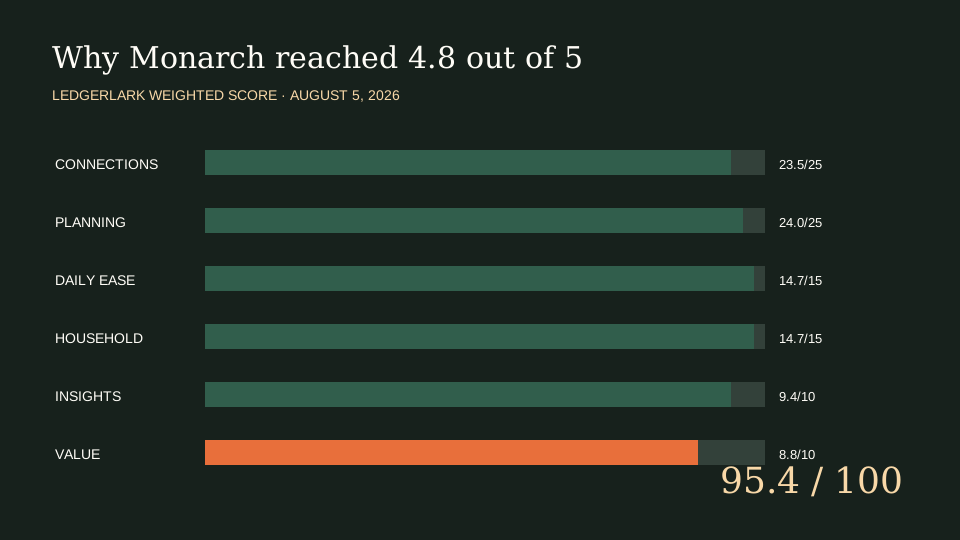
How Monarch Money scored
| Category | Weight | Score | Weighted points | Desk note |
|---|---|---|---|---|
| Connections & accuracy | 25% | 4.7/5 | 23.5/25 | Broad coverage; two manual refreshes |
| Budgeting & planning | 25% | 4.9/5 | 24.5/25 | Flexible and category modes excel |
| Daily ease | 15% | 4.8/5 | 14.4/15 | Fast review workflow |
| Household tools | 15% | 5.0/5 | 15.0/15 | Separate logins, shared plan |
| Insights & goals | 10% | 4.7/5 | 9.4/10 | Useful trends, solid goals |
| Value | 10% | 4.3/5 | 8.6/10 | Premium price, complete product |
| Total | 100% | 4.8/5 | 95.4/100 | Best overall |
The budget bends without breaking
Monarch supports category budgeting and a newer flex approach. Category mode assigns an amount to every line; flex mode separates fixed costs, non-monthly expenses, and a flexible spending pool. We preferred flex for an ordinary month because a larger grocery bill did not require five tiny transfers. People who want exact envelopes can keep the traditional method.
Rollover settings are granular, planned one-off expenses have a sensible home, and rules can rename merchants, apply categories, add tags, or hide transactions. Automatic categorization was good rather than magical: 91 of our first 100 routine transactions landed correctly. Once rules were added for a local market and payment processor, repeat errors largely disappeared.
One subscription works like a household
Monarch gives partners separate credentials under one paid household. That sounds minor until compared with sharing a password or reconciling two independent plans. In our test, one person reviewed daily purchases while the other adjusted a home-repair goal. Both saw the same numbers, and neither needed the other’s banking credentials.
Goals connect longer-term intent to current accounts. The allocation is not moving cash; it is telling Monarch which balance supports which goal. That distinction is explained clearly in the interface. The net-worth and cash-flow reports are strong enough for monthly reviews, though active investors will still want their brokerage tools for tax lots and performance attribution.
Price and the closest alternative
As of August 5, 2026, the official Monarch Money homepage lists Core at $14.99 per month or $99.99 per year after a seven-day trial. We judge standard pricing, not temporary welcome discounts. An annual subscriber pays the equivalent of $8.33 monthly.
The price is easiest to defend for a couple replacing separate apps, or for anyone consolidating budgets, goals, investment balances, and net worth. Our Quicken Simplifi review finds a better bargain for streamlined cash-flow planning. In our direct Monarch versus Simplifi comparison, Monarch wins narrowly because planning and collaboration carry more weight than price alone.
Who should use it?
Choose Monarch if you want one tidy place for day-to-day spending and the bigger household picture. It is especially good for couples, professionals with several account types, and former spreadsheet budgeters ready to automate imports without surrendering custom categories. Skip it if you refuse subscriptions, need rigorous zero-based coaching, or track only one checking account.
For other styles, our best budgeting apps of 2026 names YNAB for method-driven planning, Goodbudget for manual envelopes, and Rocket Money for subscription cleanup. Monarch is not universally best; it is the most complete balance of capability and usability we tested.
For a closer look at the reporting layer, our guide to five Monarch Money charts shows the exact filters and decisions we used. Readers building a lighter rhythm can also try the five-minute morning budget check.
Monarch Money FAQ
Is Monarch Money worth $99.99 per year?
Yes for couples, families, and people who want budgeting, investments, goals, and net worth in one polished service. A shared household needs only one subscription, which improves the value. If you mainly need a quick monthly spending plan, Quicken Simplifi delivers the essentials for much less.
Does Monarch Money have a free version?
No. On August 5, 2026, Monarch listed a seven-day free trial, then $14.99 month-to-month or $99.99 annually for its Core plan. The trial requires a payment method, so set a reminder before it ends. Occasional promotions can reduce the first-year price, but we score the standard rate.
Can couples use one Monarch Money account?
Yes. A household subscription lets partners use separate logins while seeing the same financial plan. Each person can connect individual and joint accounts without sharing bank passwords. During our test, this was Monarch’s clearest advantage: both partners could review transactions and goals without maintaining duplicate budgets.
What is Monarch Money’s biggest weakness?
Its biggest weakness is value for a simple use case. At $99.99 per year, Monarch is expensive if all you need is spending categories and a monthly safe-to-spend number. Connection quality also varies by financial institution, and investment reporting is useful for oversight rather than detailed portfolio analysis.
Testing note: Nora used purchased access and received no consideration from Monarch. The company did not review this article. Read the full LedgerLark methodology.